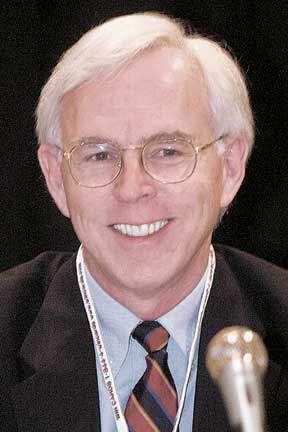
Casino regulatory agencies face a variety of challenges—recalcitrant licensees, enraged patrons, media critics and constantly evolving technology to name but a few. Yet some of the most confounding challenges arise from within. As Walt Kelly’s famous cartoon possum, Pogo, put it: “We have met the enemy, and he is us!” The “enemy” in our world may be in the form of what we euphemistically call “partner agencies.”
Gaming companies have historically made a huge proportion of their revenue from only a small proportion of their customer base. A senior casino executive who did not wish to be named once told us that “50 percent of the revenue comes from only 1 percent of the customers.” This huge skew, combined with a massive overall reduction in wealth (the Dow Jones Industrial Average, for example, has gone down 36 percent in one year), places the key revenue drivers of gaming business at risk in today’s economy.
The quickest route to an embarrassing comeuppance for professionals is to stray outside the area of their expertise. As regulators, our comfort zone is bounded by the rules and internal controls related to things like asset protection and game integrity.
Henry had been given the task of balancing the casino's dealer and floor supervisor schedule. After several weeks, he had finally developed a plan that would properly balance the schedule so that all dealer and floor shift positions were staffed to handle the current business level during the various hours of the day and week. He also was able to schedule an extra dealer for each shift to cover any vacations or call-ins.
Having studied cycles and cycle sizes in the last few installments of the Vicious Cycle series, we now have more insight into how the cycle size is calculated and why certain machines have larger cycles. Apart from the geometric progression caused by an increasing number of reels, there is another important factor that can determine the size of the cycle. This is, of course, the number of stops per reel. However, this isn't an arbitrary value selected by the game designers.
By almost any economic indicator, we are facing unprecedented times in the modern casino industry. The mega casinos in Las Vegas and the Vegas-style casinos across the U.S. and the Bahamas have heretofore been relatively insulated from the economic downturns of the recent past. But this recession is different; it has squarely struck the casino industry.
Several years ago, I had the opportunity to travel to the destination gambling-center of Macau. This pennisula, adjacent to the Chinese mainland, has provided gamblers with an opportunity to wager on games of chance for more than a hundred years. Most recently, Macau has reverted back to the Chinese government from which it originated.
Today most of us are well aware of a scam that came to light in May 2007 after a federal indictment was handed down in a Seattle U.S. District Court that named 19, and later 24, people for allegedly cheating 18 casinos (10 of which were tribal) in several states by using a false shuffle.
Nomenclature is one of the most powerful forces in business. Often it doesn’t matter what something actually is; it matters what we call it. “High yield debt” sounds much better than “junk bonds,” which sounds better yet than “toxic paper.” In our industry, we’ve got plenty of fancy names. But there is probably no term less understood by industry insiders than that which we tend to call “free play.”
Last month we discussed the importance of a properly conducted regulatory investigation and some of the challenges involved with getting them right. In this article, we will discuss the equally difficult task of presenting the data and information gathered during the investigative phase into a logical, coherent, well-documented and comprehensible written report.