



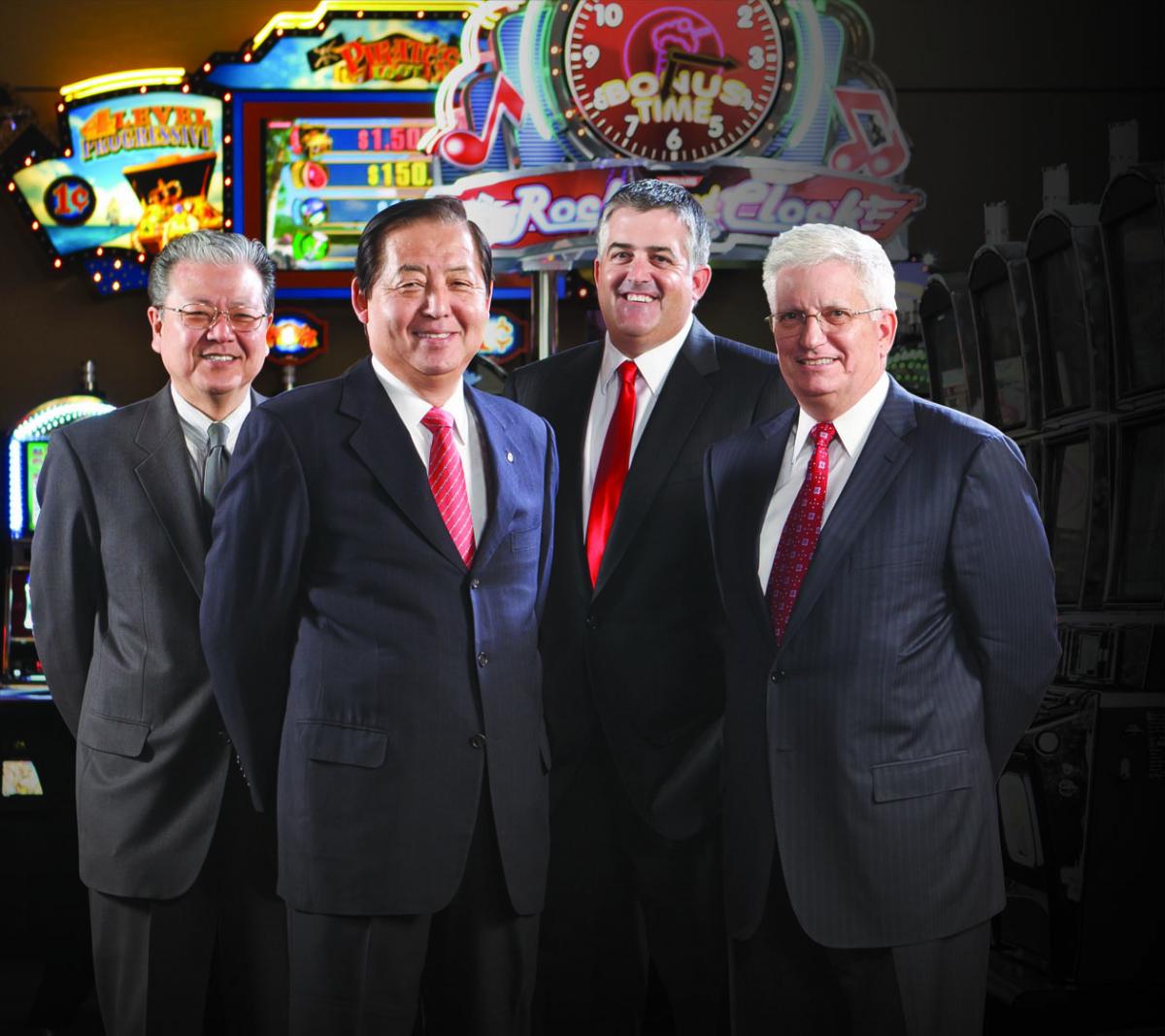
 When the current executive team for Konami Gaming Inc. formed, they were all in search of a spark. One left three decades with a single employer “looking for excitement.” Another believed in the gaming equipment manufacturer’s capacity for a seemingly unparalleled growth story. A third felt the company’s deeply-rooted “entertainment DNA” in his own bones. Together, they found that inspiration at Konami, dreaming up products that are Born From Fun™ and built with a focus.
“The company goal is to be the No. 1 game supplier in the world,” according to Konami Gaming Inc.’s Chief Operating Officer and Executive Vice President Steve Sutherland.
This shared vision existed even before Konami snuck up on the industry in the mid-2000s, when the subsidiary of the Japanese content giant KONAMI CORP. experienced triple-digit growth. Today, they’ve reached a new slot in the gaming hierarchy, with more than 280 licenses operating in every available market.
“Five years ago, we were a manufacturer kind of on the outside looking in to the big boys,” said Thomas Jingoli, chief compliance officer and vice president of Konami Gaming Inc. “And now, we’re clearly one of the big boys.”
Making a Business of Fun and Games
For more than 40 years, Konami’s parent company has made a lucrative business of fun and games. Founded in 1969 by still-chairman and CEO Kagemasa Kozuki, KONAMI CORP. began as a jukebox rental and repair business in Osaka, Japan. Over the decades, it grew to be a world leader in entertainment software, with a current market cap of nearly $3.5 billion.
Known initially for arcade titles like Frogger and Super Cobra, KONAMI CORP. later created video games for PCs and other game platforms like Nintendo, Sega and PlayStation.
Then came 1996, when the subsidiary known as Konami Gaming Inc. began building roots.
At this time, current CEO and President Satoshi Sakamoto founded Konami Australia Pty Ltd. in Sydney to serve the Asia-Pacific marketplace. Encouraging Kozuki to enter the casino gaming business, Sakamoto pioneered entry into an industry he admits knowing little about.
“We started from nothing,” he said.
Within a year, that new venture quickly grew to the U.S. with Konami’s incorporation into Nevada, making it the first Japanese publicly listed company to achieve full-scale entry in the U.S. gaming market.
Then came 2004, when Sakamoto undertook what he calls Konami’s biggest success to date—the construction of the company’s new two-story facility in Las Vegas. The act, he says, that also built the foundation for Konami’s future.
“That was a big step for me to take,” he explained.
Situated in the Hughes Airport Center, the 120,000 square-foot facility now accommodates Konami’s game and systems research and development, as well as manufacturing and distribution. Created of concrete, glass and commitment, Konami’s executive team credits this singular investment with much of the trust it’s received from customers since.
“It clearly sent a message to our competitors and our customers that Konami was in this for the long haul,” Jingoli said. “That’s really when the company started to gain some momentum in the market space.”
The Best Kept Secret: Konami’s Games and Systems
Two hundred eighty licenses. Eight hundred fifty tribal and corporate casino customers. Sales in 39 states, territories and provinces in the U.S. and Canada.
But still, the words practiced and preached by Konami Gaming Inc.’s Chief Administrative Officer and Vice President Ryoichi Kimura echo throughout the executive team: “Always, we have to stay humble.”
“We’re fighting Goliath out there,” Sutherland adds of the other top gaming manufacturers.
Despite the size and stature of the competition, Konami has transitioned from fighting the giant to becoming one itself. In September 2011, Konami announced it had grown to 14 percent ship share, up considerably from 4 percent just five years earlier. This growth pushed the company into place as the fourth-largest slot manufacturer, while still gaining share on the competition.
Sutherland largely credits those successes to the launch of the Advantage 5® platform, the Podium® cabinet and the retooling of the company’s systems offerings.
Advantage 5
Today, operators know Konami’s Advantage 5 platform as a 5-reel stepper featuring full-sized mechanical reels, full-color reel backlighting, top-box infinity lighting and a 19-inch touchscreen. In its infancy though, the platform met the industry with disadvantageous timing.
“We had a 5-reel product that we could have released within months of the competitions,” Sutherland recalled. “If we had released the original platform we came up with, it would have been a ‘me too’ product. Mr. Sakamoto and I discussed, and decided we needed to take it to another level.”
To step up the stepper, Konami mixed development components ready for release with concepts from Konami Digital Entertainment Group, the branch of KONAMI CORP. specializing in home computer and video games. It was out of that collaboration that enhanced features like the emotive lighting and advanced reel structure were born.
“It was really a home-run product,” Jingoli said.
“Right after that, we started to see the competition copy us,” Sutherland added. “That’s probably the greatest form of flattery.”
Podium Cabinet
While a rose may smell as sweet by another name, Konami’s Podium wouldn’t stand quite as symbolically. Within one word, Podium signifies a sleek cabinet, an industry top-seller and a recurring goal for the company. Named after the Olympic medal stand, Podium represents Konami’s desire to rank among the leading gaming manufacturers—and to eventually grace the gold.
“We’d like to be standing on the podium within the top three. That’s our goal this year,” Sakamoto said.
Konami’s executive team agrees Podium pushed that finish line a bit closer. Calling on the renowned firm Stuart Karten Design, Konami looked outside of the gaming industry to eliminate some of the biases within it. By interviewing stakeholders, casino operators and most importantly, avid slot players worldwide, the company learned how to better utilize lights, sound and ergonomics.
“You’ll be speechless. And that’s because the focus groups we conducted weren’t,” reads a Podium product sheet.
From that feedback came the 360-degree lighting panels, edge-lit color-changing LEDs and direct and indirect hi-fi speakers packed into a smaller footprint. Even then though, Konami added another twist, known as the Podium Slant.
Challenging operators to “slant fun and revenue” in their favor, Podium Slant further enhances a player’s amusement experience. Compatible with the KP3™ video platform, it features vertical and horizontal lighting, real-time 3-D capabilities, pinball-style buttons and upgraded sound capabilities.
“The process we’ve been following has been very well thought out,” Sutherland said.
But even more so, it’s been well executed.
KCMS
“I felt the industry was at least 20 years behind when I came over from high-tech,” Sutherland recalls of the systems architectures he experienced in gaming after a career in computers.
When he joined Konami in 2000, Sutherland not only convinced the company to get into the systems business, but to structure its offering around solutions that were based on some of the best practices found in other industries’ enterprise management solutions. His fresh perspective allowed Konami to build its system largely from the ground up in a way that questioned gaming industry norms and focused on operators’ needs. He saw failure rates as being too high and acceptance of the most robust technology too low. Too often, casino operators were being forced to utter the dreaded words, “I’m sorry, but our system is down,” to customers they were fighting desperately to keep in increasingly competitive markets. To eliminate that, Konami chose infrastructure typically seen in the financial sector, by utilizing the strength of an Oracle database, TCP/IP-based networks and Java development tools. As a result, Konami’s system has been celebrated for its unparalleled reliability.
Built on this solid foundation, the Konami Casino Management System, now known as KCMS™, is an industry-leading, real-time and multi-site relational database that features multi-channel streaming video and analytics at the game and patron level. Since 1998, KCMS has supported a fully networked floor, becoming multi-lingual in 2005. KCMS has had GSA System-to-System (S2S) interfaces in place since that same time, while also supporting G2S machine protocols. But what do Konami executives and casino operators believe is the main benefit of KCMS? It doesn’t go down.
“The overall design is to guarantee maximum up-time,” Sutherland said. “For the majority of our competition, their systems are integrated amongst various modules, where ours is one. It’s one database. And it doesn’t break.”
For Konami executives though, what isn’t broken can still be bettered. In that light, Sutherland says the company must do a better job communicating KCMS’ powerful marketing and analytics capabilities. Sutherland and his team will begin their own campaign to promote the possibilities that exist with KCMS’ powerful rules-based bonusing engine, engaging floor wide bonusing games, and robust patron tracking capabilities.
To even further strengthen those KCMS offerings, Konami is going mobile. Teaming up with Joingo™, a leading mobile and social technology company, Konami KCMS Mobile Apps will allow players and operators access to even more data on Android™, BlackBerry® and iPhone® devices.
From loyalty point totals and promotional free play credits, to LotABucks™ progressive jackpot totals and available comps, the apps open new gaming options to guests anywhere, any time. This development will allow casinos with KCMS to deepen their relationships with their guests and create the type of loyalty sought by operators everywhere.
Easily recognizable by clients, Sutherland says the strength of Konami’s systems has even earned the company the accolade of the “best kept secret in the industry.”
But as Sakamoto, Kimura and Jingoli agree, the real goal is for that secret to get out.  Competition vs. Caution: The Balance Ahead
While Konami leaders continue to reach for new products, new technologies and new growth, they know the company’s future rests upon the support of its past.
“I think it’s most important that the customer is happy,” Sakamoto simply stated.
And they are. On six continents.
Currently targeting North America, Konami sees its key—and perhaps only—opportunities for expansion in new markets that open. Already licensed in every other major jurisdiction worldwide, the company has filed applications in Ohio, Maine and South Dakota, with an eye on Massachusetts.
Globally, another news-making and revenue-generating market is South America. Entering the region three years ago, Sutherland says Konami is now “reaping the benefits of growth there.” He credits that success to the company’s implementation of a distribution network, which places representatives in every market, supported by internal project managers and service personnel.
That same system has also taken root in Europe, where the earliest distribution network adopters celebrated their one-year anniversary with Konami in January. Even with those customer relationships strengthening, Kimura calls the economic crisis there a budgetary concern for fiscal year 2013.
“How should we plan for this?” he asked of the unknown European impact on the Chinese and Macau markets. “That’s the challenge I’m facing right now.”
But to Konami’s executive team, a challenge is by no means a crutch.
“We’ve clearly made strides over the past three years,” Jingoli said. “But we’re not satisfied with where we’re at. We’re trying to continue to go further.”
There remains one market, though, that Jingoli says they’re hesitant to enter: the emerging world of online gaming.
“We’re not sure we want to compete with our customers at this point in time,” he explained.
Breaking with the company’s current business model, Konami sees i-gaming as a trend to be monitored instead of a risk to be taken. If and when full Internet gaming comes online, Jingoli says Konami will consider serving as a content provider for its online casino customers. Until then, they’re choosing caution over competition.
“I will never forget how the customers have helped us,” Sakamoto recalls of his time building Konami Gaming Inc. “They have a big investment. So now, we have to help them.”
A Winning Team
In Japanese, Konami means “small wave,” but it’s been said over the years that the company’s reach and standing has grown to a tsunami.
Its relationships and people, though, remain rooted in those leaner times. Sakamoto calls it loyalty. Kimura, humility. Sutherland, gratitude. As business models go, Konami’s manages to mix amusement with ambition and appreciation.
“I tell the sales people you need to thank customers for their orders time and time again,” Sutherland said.
Perhaps that’s how they’ve managed to increase employee head count during a recession, or why they’ve chosen to accommodate operators and resist outside recommendations to raise prices. Or how, thanks to the dedication and diligence of every Konami employee, they’ve overcome the challenges and moved within one place of their yearly goal—to stand amongst the top three slot manufacturers in the industry.
A podium they just began competing for 15 years ago.
Shana Sager is the New Media Editor for Casino Enterprise Management. She can be reached at editor7[at]aceme.org.
Comments
konami games for home use
yes i agree it would be nice to be able to try for home use let me know if it comes ableable for the pc or wii or anything thanks
slots system?
I really like slots and not so long ago i came across with a interesting article (http://www.777.com/casino-articles/fruit-machine-guide) clamming that every slot machine can be beaten!
Is that applies to konami's machines also in your opinion?
video slot games for the PC
Masque Publishing Co. produces IGT casino video slot games that can be downloaded on the home PC. Phantom EFX does the same for WMS. Do you now or are you planning to join in and allow people to experience your games before venturing onto the casino floor. Not only would you make extra profits from this distribution but it also allows the patrons to figure out the game and find their favorites so they have a better idea of how to play the real thing at their favorite casino. I would be interesting in hearing from you regarding any of these available games for purchase. Thank you.
Post new comment